
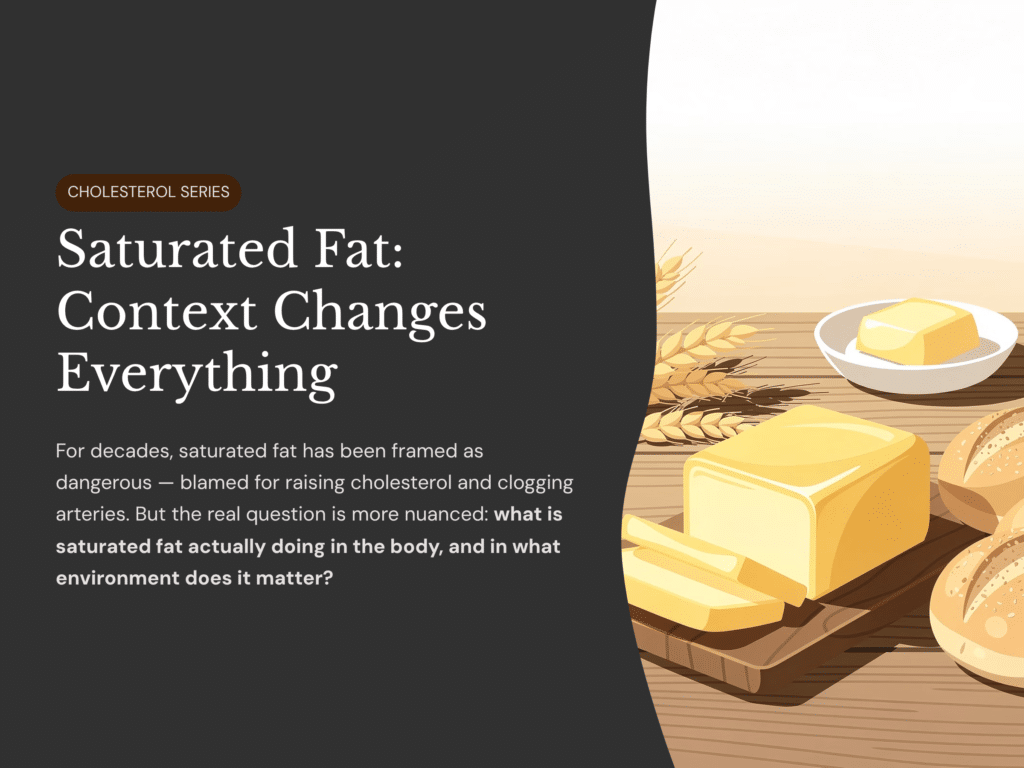
Saturated Fat Isn’t the Problem: Context Is
For decades, saturated fat has been treated as the dietary villain.
It’s been blamed for:
- raising cholesterol
- clogging arteries
- increasing cardiovascular risk
But once you understand the broader physiology, a more important question emerges:
What is saturated fat actually doing in the body — and in what context does it matter?
Because like most things in biology:
The effect of a nutrient depends on the environment it enters.
Watch the Video Version
Prefer to learn this visually? Watch the full lesson below:
What Saturated Fat Actually Is
Saturated fat is a type of fat whose chemical structure makes it:
- more stable
- less reactive
- less prone to oxidation
This stability matters.
Because in biological systems — especially under conditions of oxidative stress — stability is not a trivial feature.
Saturated fats are found in foods like:
- meat
- eggs
- butter
- dairy
- coconut
And importantly:
They have been part of human diets for a very long time.
Across traditional cultures, diets rich in whole foods — including animal fats — were consumed without the same patterns of modern chronic disease we see today.
That alone should make us pause.
Saturated Fat Is Not Just Fuel
Saturated fat is often reduced to “just calories.”
But it plays meaningful roles in the body, including:
- cell membrane structure
- hormone production
- energy stability
- insulation and protection
- cellular signaling
And because of its chemical stability, it is less prone to lipid peroxidation than many more unstable fats.
Again:
This is not an inherently dangerous molecule.
That doesn’t mean context doesn’t matter.
It means the nutrient itself deserves a more intelligent conversation.
Why Saturated Fat Was Blamed
Saturated fat became the target because of the model we discussed earlier:
Fat raises cholesterol → cholesterol causes heart disease
So naturally, saturated fat became the primary dietary villain.
But that model didn’t account for things like:
- inflammation
- oxidative stress
- insulin resistance
- endothelial health
- metabolic stability
And without those variables, the conclusion was incomplete.
That is the real issue.
Not that saturated fat was ever questioned — but that it was reduced to a single simplistic story.
What Most People Were Never Told
There are a few simple truths about saturated fat that rarely make it into the mainstream conversation.
And once you hear them, it becomes much harder to keep seeing saturated fat as the villain.
Human Breast Milk Contains Saturated Fat
Human breast milk — the most biologically intelligent food we know — contains a significant amount of saturated fat.
It is designed to:
- grow the brain
- build the nervous system
- support immune development
- sustain rapid growth
So we have to ask:
Why would nature design the most foundational human food this way if saturated fat were inherently harmful?
That question alone should make us think more deeply.
Animal Fats Are Not Purely Saturated
Another common misconception is this:
“Animal fat = saturated fat”
But that’s not actually true.
Animal fats are mixed fats.
For example:
- beef contains a large amount of monounsaturated fat
- pork is often higher in monounsaturated fat
- butter contains a mix of saturated, monounsaturated, and small amounts of polyunsaturated fat
These are not isolated nutrients.
They are complex, naturally balanced fat systems.
That distinction matters.
Saturated Fat Was Never Historically Eaten in Isolation
Historically, saturated fat was consumed:
- as part of whole foods
- within nutrient-dense diets
- alongside balanced fat profiles
- within metabolically stable lifestyles
It was not typically consumed:
- in isolation
- inside highly processed food environments
- in the context of chronic sugar overload and metabolic dysfunction
That means we cannot evaluate saturated fat intelligently without also evaluating the environment it’s being consumed in.
Context matters more than the nutrient itself.
The Real Question Isn’t the Fat — It’s the Environment
What changed in modern times wasn’t just fat intake.
It was:
- the removal of traditional fats
- the rise of refined carbohydrates
- the introduction of industrial oils
- increasing metabolic instability
So instead of asking:
Is saturated fat the problem?
A better question is:
What changed in the environment that made the system unstable?
That is a much more useful place to begin.
Context Changes Everything
Saturated fat behaves differently depending on the metabolic terrain.
In a metabolically unstable environment
When the system is marked by:
- high insulin
- high blood sugar
- inflammation
- oxidative stress
…excess energy — whether from fat or carbohydrate — can contribute to dysfunction.
In a metabolically stable environment
When the system is characterized by:
- regulated insulin
- stable blood sugar
- low inflammation
- good metabolic flexibility
…saturated fat can function as:
- a stable energy source
- part of normal lipid transport
- part of a balanced metabolic system
Same nutrient.
Different outcome.
That is the power of context.
A Systems-Based View of Saturated Fat
So how should we think about saturated fat?
Not as:
- universally dangerous
- or universally beneficial
But as:
one variable inside a much larger system.
It is:
- a natural component of whole foods
- a structurally stable fat
- part of human physiology
And its effects depend on:
- the metabolic environment
- the dietary pattern
- the overall terrain
That is a far more intelligent framework than simply calling it “good” or “bad.”
Final Takeaway
If you remember one thing, let it be this:
Saturated fat didn’t suddenly become dangerous.
The environment it’s being consumed in changed.
And once you understand that, you stop fearing a single nutrient —
And start paying attention to the system as a whole.
That is where the real conversation begins.


