
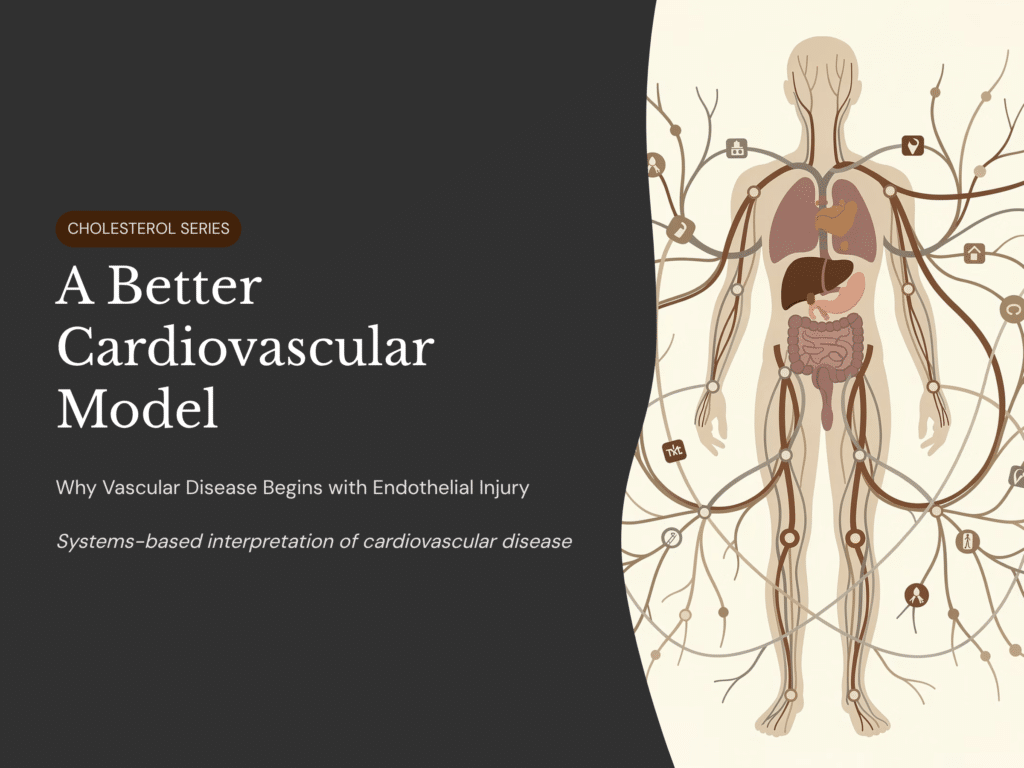
For decades, we’ve been taught a simple explanation:
Cholesterol builds up and clogs arteries.
But when you actually study the physiology of cardiovascular disease, that story doesn’t hold up.
Because plaque doesn’t just appear out of nowhere.
It develops through a sequence.
And that sequence begins much earlier — before cholesterol ever becomes part of the picture.
Watch the Video Version
Prefer to learn this visually? Watch the full lesson below:
The Missing Piece: The Vascular Endothelium
At the center of this process is something most people have never been taught about:
The endothelium
The endothelium is a thin layer of cells that lines the inside of your blood vessels.
But it’s not just a passive lining.
It is active, intelligent tissue that helps regulate:
- blood flow
- vascular tone
- permeability
- nitric oxide signaling
- immune communication
- clotting balance
- nutrient transport
- repair signaling
In other words:
It controls the terrain of your vascular system.
And when that terrain is healthy, everything flows more smoothly.
But when it becomes damaged, the entire system begins to change.
Heart Disease Is a Terrain Problem
This is one of the most important shifts in understanding:
Cardiovascular disease is not just a cholesterol problem — it’s a terrain problem.
And that terrain starts with the health of the endothelium.
When the vascular lining is:
- stable
- resilient
- well-regulated
Risk is lower.
When it becomes:
- inflamed
- irritated
- dysfunctional
Risk begins to rise.
That distinction changes the entire conversation.
What Damages the Endothelium
The endothelium doesn’t become damaged randomly.
It responds to stress.
Common drivers of endothelial injury include:
- smoking
- high blood pressure
- insulin resistance
- elevated blood sugar
- oxidative stress
- chronic inflammation
- infections
- toxic burden
- poor nitric oxide signaling
- environmental stressors
This is not a single-cause problem.
It is the result of repeated micro-injury over time.
That’s an important reframe.
Because once you understand that vascular disease develops through repeated stress and damage, you stop looking for a single villain — and start looking at the terrain.
What Happens After Vascular Injury
Once the endothelium becomes damaged, a sequence begins.
This is the part most people were never taught.
Step 1: Endothelial Injury
The vascular lining becomes irritated or dysfunctional.
Step 2: Increased Permeability
The vessel wall becomes more porous and reactive.
Step 3: Repair Traffic Arrives
Immune signals, transport particles, and repair materials begin interacting with the damaged area.
Step 4: Oxidation and Inflammation
The environment becomes more reactive, unstable, and inflammatory.
This is the beginning of plaque formation.
Not cholesterol acting alone.
But a response to injury in a compromised environment.
That is a much more intelligent model.
Where Cholesterol Actually Fits In
This is where the narrative often gets flipped.
Cholesterol is not meaningless — but it’s also not the starting point.
A more accurate way to think about it is this:
Cholesterol is part of the body’s transport and repair system.
It travels in lipoproteins (like LDL), carrying materials needed for:
- structure
- hormone production
- cellular repair
- tissue resilience
So when the vascular environment becomes damaged, those particles are more likely to become involved in the area.
Not as the original cause —
But as part of the response.
This is why I often say:
Cholesterol is often at the scene of the crime — but that doesn’t mean it caused the crime.
That distinction matters.
Why Oxidation Changes the Story
When lipoproteins enter a damaged, inflamed environment, something important can happen:
They can become oxidized.
And this is where things become more problematic.
Because:
- healthy transport particles are not the same as damaged, oxidized lipids
- stable cholesterol is not the same as unstable inflammatory debris
Oxidation is driven by things like:
- inflammation
- high blood sugar
- toxic burden
- smoking
- poor antioxidant status
- metabolic dysfunction
So a better question is not simply:
How much LDL is there?
A better question is:
What kind of environment is that LDL moving through?
That’s where the real story begins.
What Plaque Actually Is
Most people imagine plaque as fat simply clogging a pipe.
But that’s not what it is.
Plaque is a complex injury-and-repair structure.
It contains:
- fibrous tissue (especially collagen)
- inflammatory cells
- immune debris
- foam cells
- oxidized lipids
- calcium (in later stages)
In other words:
Plaque is not just fat — it’s damaged repair.
That distinction changes everything.
Because once you understand plaque as a response to injury rather than a random fat deposit, you begin to think about prevention in a very different way.
The Role of Insulin and Metabolic Dysfunction
One of the most important upstream drivers of vascular damage is:
Insulin dysregulation
Repeated insulin surges and blood sugar instability can contribute to:
- oxidative stress
- inflammation
- vascular irritation
- poor metabolic flexibility
- immune burden
Which helps explain why cardiovascular disease often overlaps with:
- weight gain
- carbohydrate intolerance
- thyroid suppression
- chronic inflammation
- gut dysfunction
This is not a coincidence.
It’s the same system under stress.
That’s why cardiovascular disease is never just about the heart.
It is often a reflection of a broader metabolic and inflammatory picture.
What We Should Actually Be Paying Attention To
If heart disease is a terrain problem, then prevention is about protecting the terrain.
That means focusing on things like:
- insulin sensitivity
- blood sugar stability
- inflammation
- oxidative stress
- sleep quality
- movement
- nutrient status
- toxic burden
- nitric oxide signaling
- microbiome health
This is where true prevention lives.
Not in obsessing over a single lab value.
And certainly not in reducing a complex disease process to one isolated number.
A More Intelligent Way to Think About Cholesterol
So does cholesterol matter?
Yes.
But only when interpreted in context.
Better questions include:
- What is the inflammatory environment?
- What is the metabolic state?
- What is the oxidative load?
- What is the vascular condition?
- What is the repair burden?
This is how we move from fear to precision.
And that is the kind of question that actually changes outcomes.
Final Takeaway
If you remember one thing, let it be this:
Heart disease does not begin with cholesterol.
It begins with:
- endothelial dysfunction
- inflammation
- oxidative stress
- metabolic instability
- repeated vascular injury
Cholesterol may become part of the lesion.
But the lesion begins upstream.
And once you understand that, the entire conversation changes.
Because now the question is no longer:
How do we lower cholesterol?
It becomes:
What damaged the terrain in the first place?
And that is the question that actually leads to better outcomes.


