The cold you caught in October is still hanging on in November.
The knee you strained last spring never fully settled. Mornings feel stiffer than they used to. Small injuries take longer to heal. You recover from a hard week, but never quite all the way.
Most people file this under one heading: I’m just getting older.
There’s a name for part of what may be happening. Researchers call it inflammaging: a quiet, low-grade inflammation that tends to build as we age.
But I want to start somewhere other than fear. What if the problem isn’t inflammation itself?
What if it’s inflammation that never quite finishes?
In short: Inflammaging is chronic, low-grade inflammation that tends to rise with age, even without an obvious infection. Inflammation itself isn’t the enemy. It’s how the body repairs. The pattern may build when inflammation starts but doesn’t fully resolve, leaving the baseline a little higher each time. Supporting resolution, in the right order, is how that staircase can begin to level out.
What inflammaging actually is
When most people think of inflammation, they picture the obvious kind. A swollen ankle. A red, hot cut. A fever.
That’s acute inflammation, and it’s a good thing. It shows up, does its job and leaves.
Inflammaging is different. Researchers describe it as chronic, sterile, low-grade inflammation that develops with age, in the absence of an overt infection. Sterile means there’s no clear invader driving it. Low-grade means you may not feel it as inflammation at all.
You’re more likely to feel it as something vaguer: slower healing, more aches, less recovery, a body that seems to wear down faster than it used to.
The term comes from the work of Claudio Franceschi and colleagues, who have spent two decades describing how this background inflammation connects aging to many of the chronic conditions that come with it: heart and vascular disease, insulin resistance, cognitive decline, loss of muscle and mobility, and a weaker response to infection.
That list can sound alarming. It doesn’t need to. Understanding how the pattern builds is what makes it workable.
Inflammation isn’t the enemy
Inflammation is how your body repairs.
When tissue is injured or an infection arrives, the immune system sends signals that bring in cleanup crews, clear injured cells and start rebuilding. Then, just as importantly, it sends a second set of signals that say: we’re done here.
That second half is called resolution. It’s an active process, not just the absence of inflammation.
When resolution is complete, the area returns to baseline. When it isn’t, a little of the signal stays on.
Here’s something that surprised me. My teacher of over 20 years, Dr. Datis Kharrazian, has pointed to research on centenarians, people who reach 100. They don’t have no inflammation. They still mount inflammatory responses. What sets them apart is that their immune systems appear to regulate those responses well and use them to clear worn and dysfunctional cells, without the damage spreading.
So the goal was never to silence inflammation.
It’s to let inflammation finish.
Why inflammaging climbs in stairs, not slopes
Picture a line on a graph showing your baseline level of inflammation across a lifetime.
It isn’t a smooth slope.
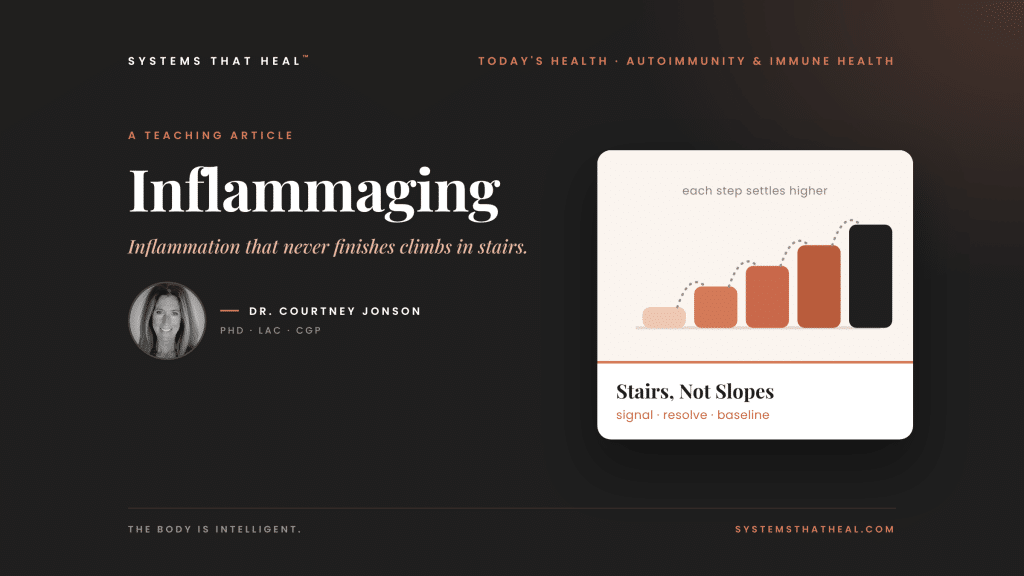
It looks more like a staircase. An infection, an injury, a stressful season or a stretch of poor sleep raises inflammation for a while. Then it comes back down, but not always all the way. Each episode may settle a little higher than the one before.
Over years, those steps add up. That rising baseline is one way to understand inflammaging.
And it can feed itself. Researchers describe a feed-forward loop:
aging → inflammaging → age-related chronic conditions → more inflammaging → faster aging
Each part strengthens the others.
This is why inflammaging is worth understanding early. The steps are easier to level out when they’re small. And it’s why a single “anti-inflammatory” food or supplement rarely changes the pattern on its own. If the signal keeps getting topped up from somewhere, calming it at the end of the line only goes so far.
The better question is: where is the signal coming from?
Where the low-grade signal comes from
Inflammaging rarely has one source. It tends to reflect several inputs at once, each adding a little to the total.
The gut barrier
This is the input I pay closest attention to.
Your gut lining is a barrier between the outside world and your bloodstream. Research on aging guts suggests the microbial community shifts over time. Protective microbes like Akkermansia muciniphila and the bacteria that make short-chain fatty acids, such as butyrate, tend to decline. Those fatty acids help feed and seal the gut lining.
As that support falls away, the barrier may become more permeable. Fragments of bacteria can slip through to where the immune system sits waiting, and it responds, again and again.
That’s a low-grade signal that can run quietly for years. (I write more about the gut and immune connection in Gut & Autoimmune Health.)
Blood sugar and insulin
Repeated blood sugar swings and chronically high insulin appear to drive what researchers call metabolic inflammation. Fat tissue, especially around the middle, can become a source of inflammatory signals of its own. (See Blood Sugar Dysregulation.)
Worn cells that don’t clear
As cells age or take on wear, some stop dividing but stay active. These are called senescent cells. In small numbers, they’re protective. But they can release inflammatory signals that affect the tissue around them, and when the immune system doesn’t clear them efficiently, they accumulate.
Cellular debris and stressed mitochondria
When cells are under strain, fragments of their contents, including pieces of mitochondria, can be read by the immune system as danger signals. A body producing more cellular wear than it can clean up keeps the alarm lightly ringing.
Stress and the brain
Stress isn’t only a feeling. Research suggests stress responses can activate inflammatory signaling in the hypothalamus, the part of the brain that coordinates hormones, temperature and energy. From there, the signal may ripple outward. (More on regulating that response in The Vagus Nerve: The Regulator of Resilience.)
Lingering load
An infection that never fully cleared. A steady chemical or mold exposure. A medication with a long tail. Each can keep the immune system on alert in the background.
Adaptation, not failure
None of this means your immune system is broken.
It’s doing what it was built to do: watching for threats and responding to signals. The trouble is that in a modern environment, many of those signals never get cleared. The barrier stays a little leaky. Blood sugar keeps swinging. Sleep stays short. Stress stays on.
So the immune system stays a little activated. That’s adaptation.
Researchers describe inflammaging as a balance between pro-inflammatory and anti-inflammatory signals. When the anti-inflammatory side keeps pace, aging tends to stay healthier. When the pro-inflammatory side outweighs it, the risk of age-related conditions rises.
There also appears to be a threshold, a point where the balance tips. Genetics influence where that point sits. But so do the conditions you live in every day.
That’s the hopeful part. Conditions can change.
Signs inflammaging may be part of your pattern
These signs may reflect a rising inflammatory baseline. None of them alone is a diagnosis.
- Colds and infections that linger longer than they used to
- Small injuries or strains that are slow to heal
- Stiffness on waking that eases as you move
- Aches that move around without a clear cause
- Slow recovery after exercise or illness
- Brain fog or low mood without an obvious reason
- Weight that settles around the middle despite effort
In blood work, I don’t look for one inflammatory marker and stop there. I look at how markers lean together:
- Is high-sensitivity CRP quietly raised?
- What do fibrinogen and homocysteine suggest?
- Is ferritin high in a way that may reflect inflammation rather than iron stores?
- Do fasting glucose and insulin point toward metabolic inflammation?
- What does the white blood cell differential show about immune activity?
A single CRP result is a snapshot. It can rise after a hard workout or a passing cold. The pattern across markers, read alongside how you feel and live, tells a much more useful story.
(If fatigue is part of your picture too, the patterns often travel together. See The Root Cause of Fatigue.)
Calming inflammaging, in order
If inflammaging builds from several inputs, the order you address them in matters.
Regulation precedes repair. A body under constant strain won’t resolve inflammation well just because you add turmeric. So I build from the ground up.
1. Fuel adequately. Under-eating is a stressor. Enough food and enough protein give the body the raw material to repair and resolve.
2. Steady blood sugar. Protein at each meal, starches paired with protein and fat, fewer swings through the day. This quiets one of the most constant inflammatory inputs.
3. Protect sleep, rhythm and the nervous system. Morning light, consistent sleep and wake times, and real recovery from stress. Much of the body’s repair and resolution work happens at night.
4. Nutrients from food. Colourful plants, omega-3-rich fish, and enough fibre from vegetables, legumes and other whole foods you tolerate to feed the microbes that make short-chain fatty acids. Food first, every time.
5. Support the gut barrier. Once the foundations are steady, attention turns to the gut lining and the microbial community that protects it. This is often where a long-running signal begins to quiet.
6. Lower the load. Look for infections that never fully cleared and exposures that keep adding to the total. This comes after the foundations, not before, because clearing works best when the body has capacity.
7. Then add the challenge. Regular movement, dosed to what you can recover from, appears to train the body’s ability to resolve inflammation. Too much intensity without recovery can push the other way.
I don’t build an “anti-inflammatory supplement stack.” Supplements have a place when testing confirms a specific deficiency, but they can’t compensate for the conditions that keep the signal going. And any change to a prescribed medication stays with the clinician who prescribed it.
This is the same sequence that runs through all of my work: Regulate, then Repair, then Release. (Why order matters so much: The Sequence Is the Method.)
Back to the system
Inflammaging isn’t a verdict on how you’re aging.
It’s a record of signals that started and didn’t fully finish.
The goal isn’t zero inflammation. Your body needs it to heal, to fight infection and to clear what’s worn out.
The goal is inflammation that finishes. That resolves. That lets each step settle back down instead of building on the one before.
That’s what resilience looks like at the immune level. (I write more about that bigger picture in Longevity Is Resilience.)
The body is intelligent. Given steady conditions, it remembers how to come back down.
Go further
If you’d like to understand what may be feeding your own inflammatory baseline, the next step is a Case Review: a functional blood panel, a Report of Findings that reads your results as patterns, and a one-on-one consultation to decide where in the sequence you begin.
This is a teaching practice. Care here comes with the understanding behind it, so what changes stays yours.
Frequently asked questions
What is inflammaging?
Inflammaging is chronic, low-grade inflammation that tends to rise with age, without an obvious infection driving it. It’s linked in research to many age-related conditions. It often builds when inflammation starts but doesn’t fully resolve, so the baseline slowly climbs over time.
What causes inflammaging?
It usually reflects several inputs at once: changes in the gut barrier and microbiome, blood sugar and insulin swings, worn cells that aren’t cleared, cellular stress, chronic stress and lingering infections or exposures. Genetics play a part, but daily conditions have a strong influence.
Can inflammaging be slowed?
Research suggests the inflammatory baseline responds to conditions like blood sugar stability, sleep, stress, diet quality, gut health and movement. Supporting those in the right order may help inflammation resolve more completely, though no approach can promise a specific outcome or timeline.
What diet helps with inflammaging?
There’s no single diet. Steady blood sugar, adequate protein, colourful plants, omega-3-rich fish and fibre that feeds the gut’s short-chain fatty acid producers all appear to help. How you eat, regularly and enough, matters as much as any single food.
What blood test shows inflammation?
High-sensitivity CRP is the most common marker, but one result is only a snapshot. Fibrinogen, homocysteine, ferritin, fasting glucose and insulin, and the white blood cell differential add context. Reading them together gives a much clearer picture than any one number.
Is inflammaging the same as autoimmunity?
No. Autoimmunity is when the immune system targets the body’s own tissues. Inflammaging is a broader, low-grade background inflammation that rises with age. They can overlap, since a persistently activated immune system and a leaky gut barrier are relevant to both.