
You fast until noon. You sit in the sauna three times a week. You’ve added a cold plunge, a hard workout most mornings and a shelf of supplements you read about on a podcast.
You’re doing everything the longevity world recommends.
And you’re more tired than you were a year ago. Your sleep is lighter. Your workouts take longer to recover from. You feel wired by evening and flat by mid-afternoon.
So I want to ask a different question. What if longevity and resilience are the same thing, and what if resilience is built less by the stress you add than by the recovery that follows it?
In short: Longevity and resilience are closely linked. Healthy aging may depend less on how much stress you put your body through and more on its capacity to meet a stressor, recover and come back more capable. Fasting, exercise, heat and cold can all build that capacity, but only when the body has the foundations to recover from them.
Longevity isn’t more years. It’s the capacity to return.
Most people think of longevity as living longer.
I think of it as staying resilient longer.
Resilience is the ability to experience a stressor, respond to it, recover and return to baseline. A hard workout. A missed meal. A poor night’s sleep. A difficult season of life.
A resilient system bends and comes back.
The problem isn’t stress itself. Stress is information. It’s how the body learns what it needs to become capable of.
The problem is stress that keeps arriving before recovery is complete. That is where longevity and resilience part ways with “more is better.”
At Systems That Heal, we have a word for this: capacity. The ability to produce energy, recover, adapt and take part fully in life. Health isn’t the absence of symptoms. It’s the presence of capacity.
The cycle that builds capacity
There’s a pattern that shows up again and again in the biology of aging. I teach it in four steps:
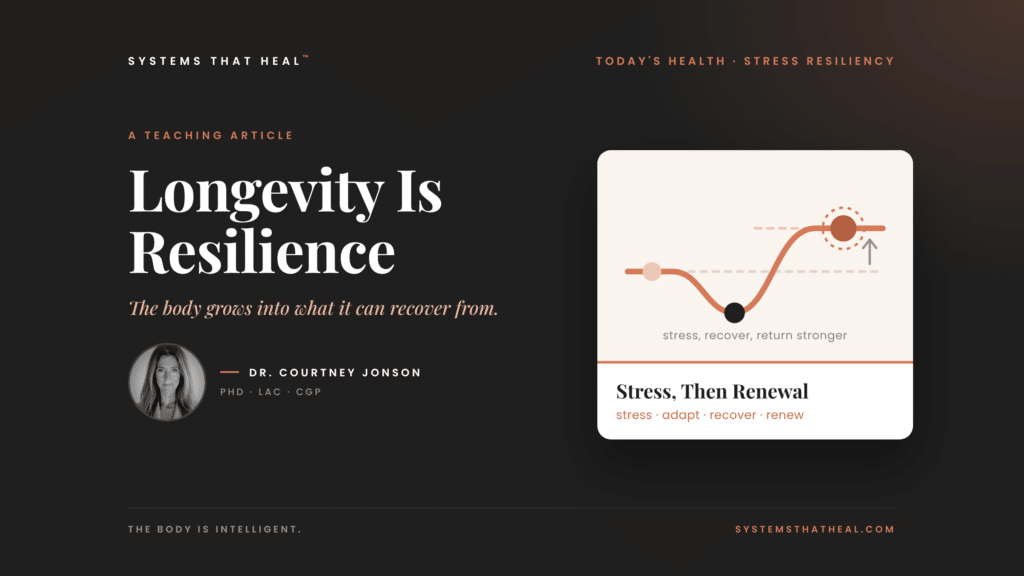
Stress → Adaptation → Recovery → Renewal
Researchers call the first half of this hormesis: a small, manageable dose of stress prompts the body to strengthen itself. Exercise, fasting, heat and cold are the classic examples.
Here’s what that may look like inside a cell.
Each cell holds hundreds to thousands of mitochondria, the structures that turn food and oxygen into usable energy. Over time, some become worn and less efficient.
A well-dosed stressor appears to activate the cell’s quality-control systems. One of these is mitophagy: identifying worn mitochondria and clearing them. Once the old material is cleared, the cell can signal for mitochondrial biogenesis, building new, healthier ones.
Activation. Clearance. Renewal. Greater capacity.
Notice what that sequence requires. The stimulus is only the beginning. The renewal happens afterward, during recovery.
The goal was never to stay activated. The goal is a stimulus the body can complete.
Mitochondria are messengers, not just batteries
You may have learned that mitochondria are the powerhouse of the cell. That’s true, and it’s incomplete.
Mitochondria are also signaling organelles. They help shape immune signaling, inflammatory pathways, metabolic signaling, how cells respond to stress, and even when a cell is retired.
So when mitochondria struggle, the effect may not be limited to “I don’t make enough energy.” It may become “the cell is receiving the wrong signals.”
This is one reason mitochondrial health points toward so much more than fatigue. It sits close to chronic inflammation, immune patterns and the way we age.
Sleep is where the cleanup completes
Sleep isn’t simply rest.
During sleep, the body has its best window for repair, for clearing cellular waste and for coordinating the metabolic rhythms that run on a circadian clock.
That changes how a longevity routine should be read.
Fasting, sauna, cold, supplements and intense exercise are all inputs that ask something of the body.
Sleep, circadian rhythm and recovery are where the body answers.
When the first list grows and the second list shrinks, the body is stacking stressors without finishing the cycle. That isn’t a longevity strategy. It’s a growing load.
Why the same stressor helps one person and drains another
This is the part most longevity advice leaves out.
The same intervention can build one person and deplete another. The difference isn’t willpower or discipline. It’s capacity.
When the stress you add stays within what your body can recover from, it adapts and grows more capable.
When stress outpaces recovery capacity, the body adapts differently. It may conserve energy. It may hold onto inflammation. It may protect its reserves.
None of that is failure. It’s an intelligent body responding to the conditions it’s been given.
Over time, though, the pattern may look like this:
persistent inflammation → strained mitochondria → less metabolic flexibility → loss of muscle → reduced resilience
That’s why one of the governing laws of my practice is strategic hormesis requires readiness. Stress should build capacity, not overwhelm it.
Signs your resilience may be thinning
Fatigue is often the first thing people notice. But fatigue is a pattern, not a diagnosis.
The useful question isn’t “Are my mitochondria the problem?” It’s this: What has reduced this person’s capacity to produce energy, recover and adapt?
That answer can involve mitochondria. It can also involve blood sugar, sleep, inflammation, nutrient availability, hormones, medications or muscle mass. More often than not it’s several at once. (I write more about this in The Root Cause of Fatigue.)
Some signs that may reflect declining metabolic resilience:
- Feeling tired or foggy after meals
- Struggling to go more than a few hours between meals
- Hunger that feels urgent rather than gradual
- Workouts that take days to recover from
- Sleep that doesn’t feel restoring
- Losing strength even while staying active
A resilient metabolism moves smoothly between being fed, digesting, fasting and drawing on stored fuel. As we age, that flexibility can narrow. (See Blood Sugar Dysregulation for how this begins.)
In blood work, I don’t look for one guilty marker. I look at how markers lean together. Do fasting glucose, fasting insulin, A1c and triglycerides point the same way? Is there a quiet inflammatory signal? Are iron stores adequate to carry oxygen? Read together, they suggest where capacity is being spent.
Muscle is a longevity organ
Muscle isn’t only about strength or appearance.
It’s metabolically active tissue. It’s one of the body’s largest places to store and use glucose. And it releases myokines, signaling molecules that communicate with other tissues, including the immune system, the brain and fat tissue.
As we age, the goal isn’t simply to avoid gaining weight.
It’s to avoid losing functional tissue.
That means protecting muscle mass, strength, adequate protein and the anabolic signals that tell the body to keep rebuilding.
And here is where longevity advice often pulls in two directions.
Fasting can activate cellular cleanup. But chronic under-fueling can undermine the very tissue that protects you as you age. I often see this in women who believe they’re eating well: lean plates, long gaps, intense training, and a body quietly giving up muscle to keep up.
Longevity isn’t about more fasting.
It’s about appropriate stress, adequate recovery and enough raw material to rebuild.
What aging looks like at the cellular level
Researchers have mapped a set of processes, often called the hallmarks of aging, that appear to drive how cells change over time. A few of them make the resilience story clearer.
Nutrient sensing. Pathways such as AMPK and the sirtuins respond to energy scarcity. You’ll often hear “fasting turns on longevity genes.” A more precise way to say it: periodic energy scarcity activates stress-response and nutrient-sensing pathways that can support metabolic adaptation and cellular maintenance.
Protein quality control. Cells constantly fold, maintain, recycle and remove proteins. With age, this system can become less efficient, and misfolded proteins may accumulate. That accumulation is linked to neurodegenerative processes, including Alzheimer’s. The issue isn’t eating “too much protein.” It’s misfolded proteins and slower clearance.
Senescent cells. These are cells that have stopped dividing but remain active. Senescence can be protective, keeping compromised cells from multiplying. The problem is accumulation. Some senescent cells release inflammatory signals that shape the tissue around them.
Environmental load. Environmental exposures may add oxidative stress and inflammatory burden, and that load can touch several of these processes at once. Not every exposure affects every person the same way. But it reinforces something I return to often: the cell is always adapting to its environment. The environment is part of the biological input.
Across all of these, a common thread appears. The mechanisms themselves aren’t bad. What changes with age is regulation and clearance.
Supporting longevity and resilience, in order
If resilience depends on recovery, then the order you build in matters.
Regulation precedes repair. The body can’t renew on unstable terrain. So before adding stressors, I look at whether the foundations are in place to recover from them.
1. Steady blood sugar. Protein-forward meals, starches alongside protein and fat rather than alone, and fewer swings across the day. When fuel delivery is unstable, the body leans on stress hormones just to stay level.
2. Fuel adequately. Enough food, and enough protein, to give the body the raw material for rebuilding. Under-fueling often hides inside “eating clean.”
3. Regulate the nervous system. A body that stays braced for threat spends its resources on protection, not renewal. (More in The Vagus Nerve: The Regulator of Resilience.)
4. Protect sleep and rhythm. Morning light, a consistent wake time, darkness at night. This is where the cleanup completes.
5. Lower inflammatory load and support digestion. Nutrients from food, a gut that can absorb them, and fewer inputs that keep the immune system on alert.
6. Then add the stressors. Strength training, fasting windows, heat, cold, intensity. Each one dosed to what you can recover from, and each one adjusted when recovery slips.
This is the same order that runs through the Live Clean Method: Regulate, then Repair, then Release. Clearing and intensifying are earned last, once the capacity exists to carry them. (Why the order matters: The Sequence Is the Method.)
You don’t need to stop doing what you love. You may only need to do it at a dose your body can complete.
Back to the system
Aging isn’t only the accumulation of years.
It may be better understood as the gradual narrowing of resilience: the ability to respond to stress, clear what’s worn, repair tissue and return to balance.
Seen this way, longevity and resilience ask the same question: how much can this body meet, and still return?
That’s hopeful, because capacity can be built.
Not by pushing harder. By creating conditions in which the body can adapt, recover and renew, and then asking a little more of it.
The body is intelligent. It will grow into what it can recover from.
Go further
If you’d like to see where your own capacity is being spent, the next step is a Case Review: a functional blood panel, a Report of Findings that reads your results as patterns, and a one-on-one consultation to decide where in the sequence you begin.
This is a teaching practice. Care here comes with the understanding behind it, so what changes stays yours.
Frequently asked questions
Does fasting help with longevity?
Periodic fasting may activate cellular cleanup and nutrient-sensing pathways linked to metabolic adaptation. But the benefit depends on recovery and adequate fuel afterward. For someone already under-eating, stressed or losing muscle, more fasting may add load rather than build capacity.
Are sauna and cold plunges good for longevity?
Heat and cold are forms of hormetic stress, and research suggests both can prompt adaptive responses. They tend to help most when sleep, blood sugar and nervous system regulation are already steady. When those foundations are thin, they can become one more demand on a stretched system.
What is hormesis?
Hormesis describes how a small, manageable dose of stress can prompt the body to strengthen itself. Exercise is the most familiar example. The key word is manageable: the same stressor at a dose the body can’t recover from may have the opposite effect.
Can you overdo hormetic stress?
Yes. Hormesis works through the full cycle of stress, adaptation, recovery and renewal. Stacking fasting, intense training, heat and cold without enough sleep or fuel can leave the body activated without completing recovery. Slower recovery, lighter sleep and growing fatigue may be signs of that.
Why does muscle matter for longevity and resilience?
Muscle is metabolically active tissue that helps regulate blood sugar and sends signals to other organs through myokines. Preserving muscle, strength and adequate protein as you age protects the body’s capacity to handle stress and recover from it.


