
The Metabolic Side of Testosterone, Progesterone and PCOS
When women think about hormones, they usually think about estrogen, progesterone and testosterone.
Insulin rarely makes the list.
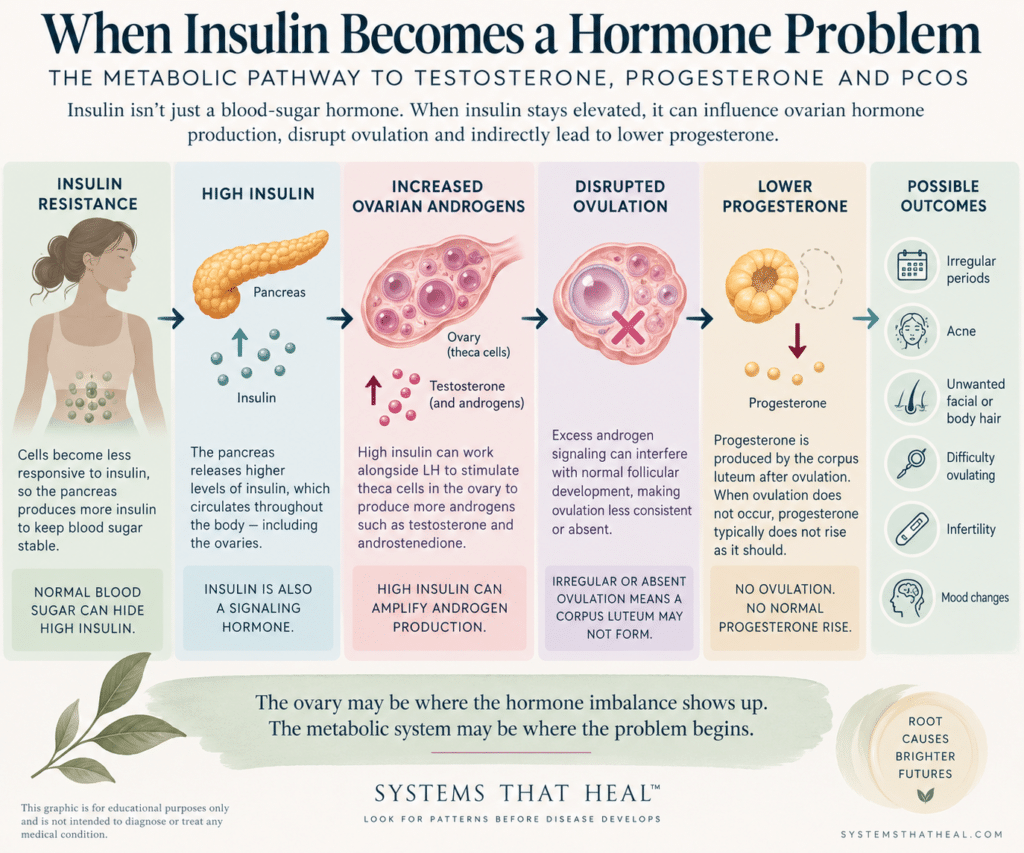
But insulin is a hormone too—and when insulin stays elevated, its effects reach far beyond blood sugar.
It can change what happens at the ovary.
It can influence androgen production.
It can interfere with ovulation.
And when ovulation becomes unreliable, progesterone changes too.
This is one reason I think we need to stop looking at conditions like polycystic ovary syndrome, or PCOS, as simply an ovarian problem.
Sometimes the ovary is where the imbalance shows up.
The metabolic system may be where the problem begins.
PCOS Is Bigger Than the Ovary
PCOS has historically been described primarily as a reproductive disorder: irregular periods, difficulty ovulating, infertility, acne, unwanted facial hair and elevated testosterone.
But that description doesn’t tell the whole story.
In 2026, an international consensus renamed PCOS polyendocrine metabolic ovarian syndrome, or PMOS—a name intended to better reflect the multiple endocrine and metabolic systems involved.
That word metabolic matters.
Insulin resistance and the resulting higher insulin levels are extremely common in women with PCOS—even in women who are not overweight.
And that gives us an important clue.
Instead of asking only:
What’s wrong with her hormones?
We can ask:
What is telling her ovaries to behave this way?
One answer may be insulin.
Insulin Is More Than a Blood-Sugar Hormone
We tend to think of insulin as the hormone that lowers glucose after we eat.
That’s true, but incomplete.
Insulin is also a powerful signaling and storage hormone.
When we eat carbohydrates, glucose enters the bloodstream and insulin helps move that glucose into cells where it can be used or stored.
In a metabolically healthy system, insulin rises when it is needed and then comes back down.
With insulin resistance, the cells become less responsive to that signal. The pancreas compensates by producing more insulin.
Blood glucose may still look relatively normal for quite some time.
But insulin can already be elevated.
And the ovaries can hear that signal.
What High Insulin Does at the Ovary
This is where the hormone story gets interesting.
The ovaries contain specialized cells called theca cells, which produce androgens such as androstenedione and testosterone.
Luteinizing hormone, or LH, normally helps regulate that process.
But insulin can amplify the signal.
When insulin is chronically elevated, it can work alongside LH to encourage greater ovarian androgen production.
The result may be higher testosterone or increased androgen activity.
That can show up as:
- acne
- facial or body hair
- scalp hair thinning
- irregular menstrual cycles
- difficulty ovulating
- infertility
But there’s another side of this story that is just as important.
High insulin doesn’t simply “turn progesterone into testosterone.”
That’s an easy way to picture what seems to be happening, but it isn’t quite how the biochemistry works.
Progesterone and testosterone belong to the same larger steroid-hormone pathway, beginning with cholesterol. Insulin can influence ovarian steroid production and favor increased androgen synthesis, but insulin itself does not aromatize progesterone into testosterone.
In fact, aromatase is the enzyme that converts androgens such as testosterone and androstenedione into estrogens.
So why do we so often see high androgen activity alongside inadequate progesterone?
Because of ovulation.
No Ovulation, No Normal Progesterone Rise
After an egg is released, the follicle that contained it becomes the corpus luteum.
The corpus luteum produces a substantial amount of progesterone during the second half of the menstrual cycle.
That means progesterone isn’t simply a hormone we should measure in isolation.
It is also evidence of something that happened upstream:
successful ovulation.
When excess androgen signaling disrupts normal follicular development and ovulation becomes irregular, the corpus luteum may not form normally.
And without normal ovulation, you don’t get the expected luteal rise in progesterone.
So the pattern can look something like this:
Insulin resistance
↓
Chronically elevated insulin
↓
Stronger ovarian androgen signaling
↓
Increased testosterone / androgen activity
↓
Disrupted follicular development and ovulation
↓
Less reliable corpus luteum formation
↓
Less progesterone
Now the hormone imbalance begins to make more sense.
Instead of three unrelated problems—high insulin, high testosterone and low progesterone—we may be looking at different expressions of the same system.
And You Don’t Have to Be Overweight
This is an especially important point.
Insulin resistance is not synonymous with obesity.
The metabolic features associated with PCOS are also found in women at lower body weights.
That means looking at a woman and deciding she “doesn’t look insulin resistant” can cause us to miss an important part of the picture.
A fasting glucose of 92 doesn’t necessarily tell us how much insulin her pancreas had to produce to keep glucose at 92.
That’s why I often want to understand more than glucose alone.
Depending on the person, that may mean looking at markers such as fasting glucose, fasting insulin, hemoglobin A1c, triglycerides and HDL, alongside reproductive hormones, symptoms, cycle history and body composition.
We’re looking for patterns, not one abnormal number.
Why Lowering Insulin Can Change Reproductive Hormones
This is also why nutrition can have effects that extend beyond weight loss.
Early research on ketogenic and lower-carbohydrate approaches in women with PCOS has reported improvements in insulin resistance, menstrual regularity, ovulation and androgen markers.
A 2023 review of seven small studies found ketogenic diets were associated with lower free testosterone, higher sex hormone-binding globulin (SHBG) and improvement in the LH-to-FSH ratio.
Interestingly, progesterone itself did not significantly change across those studies.
That distinction matters.
The goal isn’t simply to “raise progesterone with keto.”
The larger question is whether improving metabolic signaling creates a healthier environment in which ovarian function and ovulation can normalize.
And some studies have reported reproductive changes occurring even without dramatically greater weight loss.
That tells us something important:
Metabolic improvement is not always the same thing as weight loss.
This Is Why I Don’t Start With “Lose Weight”
Telling a woman with insulin resistance to simply lose weight misses the physiology.
Her body may already be compensating for an environment of elevated insulin, altered hunger signaling, impaired metabolic flexibility and disrupted reproductive signaling.
Weight may be part of the presentation.
It isn’t necessarily the starting point.
I would rather ask:
What inputs are creating the hormonal environment we’re seeing?
- Nutrition matters.
- Muscle matters.
- Sleep matters.
- Stress matters.
- Movement matters.
- Meal frequency may matter.
- And carbohydrate tolerance can matter tremendously.
The goal isn’t to punish the body into losing weight.
The goal is to change the signals the body is receiving.
Ketosis Is a Tool, Not the Point
For some women, a well-formulated ketogenic or lower-carbohydrate diet can be a useful therapeutic tool for lowering insulin exposure and improving metabolic flexibility.
But simply chasing ketones isn’t the goal.
A woman can eat too little food, too little protein, become chronically stressed and call it “keto.”
That isn’t the metabolic environment I’m trying to create.
The body still needs to be resourced.
- Adequate protein matters.
- Micronutrients matter.
- Minerals and electrolytes matter.
- Muscle matters.
- Sleep matters.
- And enough food matters.
The objective is not carbohydrate restriction for its own sake.
The objective is to create conditions in which the metabolic system no longer needs to compensate so aggressively.
Follow the Signal Upstream
This is the larger lesson I take from PCOS.
Hormones don’t operate independently.
The reproductive system is listening to the metabolic system.
The metabolic system is listening to nutrition, movement, sleep, stress and energy availability.
And the ovaries respond accordingly.
So when I see high testosterone, irregular cycles, low progesterone, acne, fertility problems or unexplained changes in body composition, I don’t want to look only at the reproductive hormones.
I want to know what is happening upstream.
- What is glucose doing?
- What is insulin doing?
- Is she ovulating?
- Is she metabolically flexible?
- Does she have enough muscle?
- Is she adequately nourished?
- What is the body adapting to?
- Because the body isn’t randomly producing the wrong hormones.
The body is responding to signals.
And sometimes the most useful thing we can do is stop chasing the downstream symptom long enough to understand the signal that created it.
The Body Is Intelligent.
At Systems That Heal™, we look for patterns of dysfunction before disease develops. Hormonal symptoms can be important clues—but understanding why those hormones changed in the first place is where the deeper work begins.
This article is for educational purposes only and is not intended to diagnose or treat PCOS/PMOS or any other medical condition. Hormonal and metabolic symptoms can have multiple causes and should be evaluated individually.


