
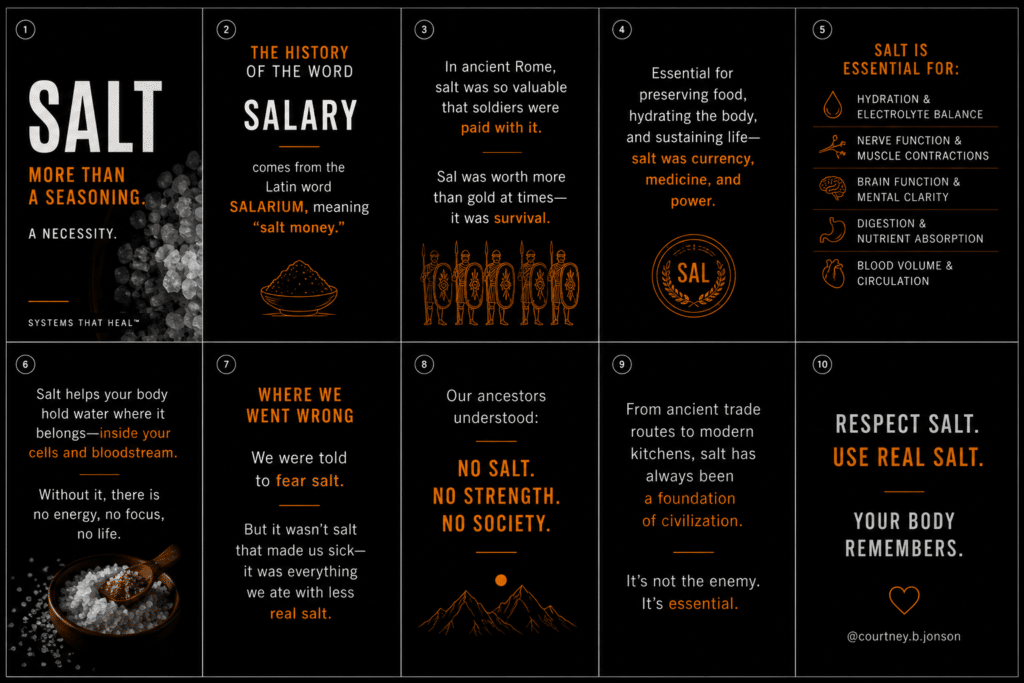
For decades, salt has been cast as a cardiovascular villain. Cut back. Watch your sodium. Pass on the shaker. And yet — the body you’re trying to protect cannot function without it.
This isn’t a contrarian take. It’s physiology.
Salt isn’t the problem. The conditions we created around it are.
Your Body Doesn’t Run Without It
Salt — specifically sodium chloride — is not a flavor additive. It is a biological requirement. Every cell in your body depends on the sodium-potassium pump to maintain its electrical charge. Without that charge, nothing moves: not nutrients, not nerve signals, not muscle contractions.
More specifically, sodium is essential for:
- Hydration and electrolyte balance — sodium is the primary electrolyte in your extracellular fluid. It determines how much water your body retains and where that water goes. Without adequate sodium, cells can’t hold fluid where it belongs.
- Nerve function and muscle contractions — electrical signaling between neurons depends on the rapid exchange of sodium and potassium across cell membranes. Blunt that exchange and you blunt signal transmission.
- Brain function and mental clarity — cognitive performance is tied to electrolyte status. Low sodium may contribute to fatigue, brain fog, and difficulty concentrating — symptoms many people attribute to stress or poor sleep.
- Digestion and nutrient absorption — sodium plays a direct role in the absorption of glucose and amino acids in the small intestine. It also stimulates hydrochloric acid production in the stomach. Low salt intake may quietly compromise digestive efficiency.
- Blood volume and circulation — sodium helps maintain the volume of blood circulating through your system. Chronically low intake can reduce blood pressure to the point of fatigue, dizziness, and poor tissue perfusion.
Salt doesn’t just make food taste better. It keeps the system running.
It Was Never About the Salt
The fear of salt took hold in the mid-20th century, largely from research linking sodium to elevated blood pressure. The logic was straightforward: high sodium raises blood pressure, elevated blood pressure raises cardiovascular risk — therefore, reduce sodium.
What the narrative missed was context.
The populations eating the most sodium were also eating highly processed food — diets stripped of potassium, magnesium, fiber, and the mineral complexity that real food provides. Sodium in isolation behaves differently than sodium consumed alongside the nutrient matrix it evolved alongside. The studies largely didn’t separate those variables.
Meanwhile, the populations that ate ancestral, mineral-rich diets with real salt — salt from sea water, from mineral springs, from ancient trade routes — didn’t show the same cardiovascular patterns.
It wasn’t the salt. It was everything people were eating with less real salt.
“Salary” Didn’t Come from Nothing
The word salary comes from the Latin salarium — from sal, meaning salt. Roman soldiers were paid in salt, or received an allowance specifically to buy it. Salt preserved food through winter. Salt sustained armies. Salt determined the rise and fall of trade routes.
Ancient civilizations didn’t revere salt because they lacked alternatives. They revered it because they understood, through direct experience, what happened when bodies didn’t have it. Energy failed. Muscle gave out. Wounds didn’t heal well. Clarity dropped.
No salt. No strength. No civilization.
That knowledge didn’t disappear — it just got buried under a century of reductive nutrition science.
What “Real Salt” Actually Means
Not all salt is the same, and this distinction matters more than most people realize.
Refined table salt is sodium chloride — period. The processing that produces it strips out the trace minerals naturally present in seawater and mineral deposits: magnesium, potassium, calcium, iodine, and dozens of other elements your body uses. What remains is pure sodium and chloride, often with anti-caking agents added.
Real salt — unrefined sea salt, Himalayan pink salt, Celtic grey salt — retains that trace mineral profile. The mineral complexity may support how your body actually uses the sodium: the co-factors are there, the electrolyte ratios are closer to what the body expects.
This doesn’t mean refined salt is toxic. It means that if you’re using salt as a functional tool for electrolyte support and hydration, the mineral matrix matters.
Signs Your Body May Be Under-Salted
The body is a remarkably adaptive system. When sodium drops, it will pull from reserves, signal thirst, and conserve where it can. But adaptation has a cost — and chronic low-sodium adaptation may be showing up as symptoms that don’t read as “salt deficiency” at all:
- Persistent fatigue despite adequate sleep
- Low blood pressure or frequent dizziness when standing
- Muscle cramps, especially at night
- Brain fog or difficulty with word recall
- Strong cravings for salty foods (the body is direct when it needs something)
- Feeling worse after exercise, sweating, or hot weather
- Headaches without clear cause
None of these confirm a sodium issue on their own. But in the context of someone eating a “clean” diet — especially one low in processed food, higher in whole foods, or involving intermittent fasting — under-salting is a genuinely common and underappreciated driver of these patterns.
How to Use Salt Intelligently
The goal isn’t to add salt liberally to everything — it’s to stop fearing it and start using it with awareness.
Use real salt. Choose unrefined sea salt, Celtic grey salt, or Himalayan pink salt as your primary source. The trace minerals matter.
Salt your food to taste. Your palate is a functional guide. If food tastes flat without salt, your body is likely telling you something.
Increase intake around sweat and exertion. Sodium is lost through sweat. Athletes, people working outdoors in heat, and anyone doing extended exercise likely need more than the average sedentary recommendation.
Pay attention when cutting processed food. Processed food is often the primary sodium source in a modern diet. When people clean up their eating and remove processed food without replacing that sodium from real sources, they can inadvertently drop electrolyte intake significantly.
Pair salt with water and potassium. Sodium works in balance with potassium and water. Getting adequate potassium from food — leafy greens, avocado, squash, legumes — supports healthy sodium function rather than working against it.
The Real Lesson
The body isn’t afraid of salt. It’s built for it.
What eroded health wasn’t the salt in traditional diets — it was the industrial food system that stripped minerals, disrupted food quality, and then blamed the one thing people had always understood to be essential.
Respect salt. Use real salt. Your body knows what to do with it.
Courtney Jonson is a licensed functional medicine practitioner at Systems that Heal. She works with adults navigating chronic, unresolved health patterns — metabolism, hormones, gut health, and nervous system dysregulation. Find her at @courtney.b.jonson.


