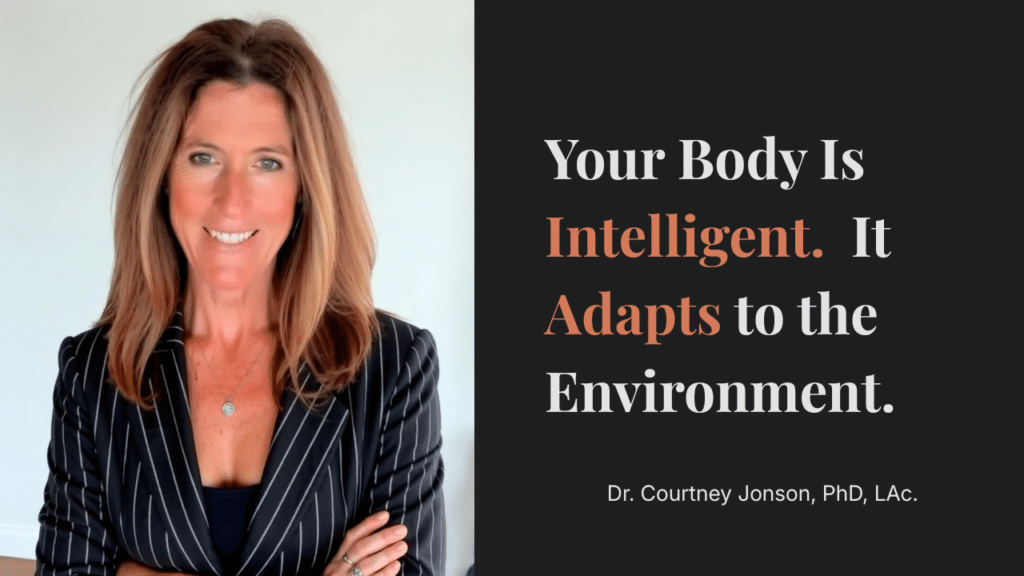
For years, we’ve been taught to think about symptoms in a very particular way.
Fatigue means something is wrong.
Weight gain means something is wrong.
Brain fog means something is wrong.
Poor sleep, digestive issues, anxiety, depression, autoimmune symptoms, hormonal changes, chronic pain—something must be wrong.
But what if we’ve been asking the wrong question?
What if many of the symptoms people experience today are not evidence that the body is failing?
What if they are evidence that the body has been adapting?
The Body Is Not Passive. The Body Is Adaptive.
One of the most remarkable characteristics of the human body is its ability to adapt.
If you lift weights, your muscles adapt.
If you spend time in the sun, your skin adapts.
If food becomes scarce, your metabolism adapts.
If you experience chronic stress, your nervous system adapts.
The body is constantly gathering information from its environment and making adjustments in an effort to survive.
This is not dysfunction.
This is intelligence.
The body is not passive.
The body is responsive.
The body is adaptive.
When we begin viewing health through this lens, many of the symptoms that seem random suddenly begin to make sense.
The Great Modern Experiment
For most of human history, the human environment changed very slowly.
Our biology had time to adapt.
But over the last century and a half, the pace of change has accelerated dramatically.
We moved from outdoor living to indoor living.
From movement to sitting.
From natural light to artificial light.
From seasonal food to food available around the clock.
From whole foods to highly processed foods.
From close-knit communities to increasingly isolated and overstimulated lives.
At the same time, many of us are sleeping less, moving less, experiencing more stress, and consuming more processed food than any previous generation.
Our bodies have not stopped adapting.
They have simply been adapting to a very different environment.
Adaptation Comes With A Cost
The body’s ability to adapt is extraordinary.
But adaptation is not free.
Every adaptation requires resources.
Energy.
Nutrients.
Recovery.
Resilience.
Over time, many people find themselves caught in a perfect storm.
The demands placed upon the body continue to increase while the resources needed to meet those demands continue to decline.
Blood sugar becomes less stable.
Sleep becomes less restorative.
Stress becomes chronic.
Inflammatory signaling increases.
Recovery becomes more difficult.
The body compensates as long as it can.
And for many years, it compensates remarkably well.
Until one day, the cost of adaptation becomes visible.
Food Is More Than Calories
One of the most important concepts in Systems Medicine is understanding that food is not simply fuel.
Food is information.
Food becomes hormones.
Food becomes neurotransmitters.
Food becomes immune signals.
Food becomes cellular structure.
Every meal provides instructions to the body.
When the quality of that information changes, the body changes.
Over the last several decades, many people have unknowingly shifted from diets built around nutrient-dense foods to diets dominated by refined carbohydrates, processed ingredients, and industrialized food products.
The body adapts.
The microbiome adapts.
Hormonal signaling adapts.
Immune function adapts.
Inflammatory pathways adapt.
The body is always responding to the information it receives.
Menopause Doesn’t Create The Problem. It Reveals The Problem.
One of the most common patterns I see in practice occurs during perimenopause and menopause.
Many women are told that menopause is simply a hormone problem.
I see it differently.
Menopause is often an adaptation challenge.
For decades, the ovaries provide significant hormonal support for the body.
As women move through perimenopause, that support naturally begins to change.
This is normal.
It is not a disease.
The body has backup systems designed to help navigate this transition.
The challenge is that many women arrive at this stage of life after years—sometimes decades—of adaptation.
They have adapted to stress.
Adapted to poor sleep.
Adapted to blood sugar instability.
Adapted to caregiving.
Adapted to career demands.
Adapted to constant productivity.
Adapted to an always-on culture.
The body compensates beautifully.
Until it reaches a point where compensation becomes more difficult.
Suddenly, symptoms that were once manageable become impossible to ignore.
Sleep changes.
Recovery declines.
Weight accumulates more easily.
Anxiety becomes more noticeable.
Energy becomes less reliable.
Menopause did not create these challenges.
In many cases, it revealed them.
It exposed the cumulative cost of adaptation that had been building beneath the surface for years.
Symptoms Are Signals
This perspective changes the conversation entirely.
Instead of viewing symptoms as enemies, we begin viewing them as information.
Symptoms are signals.
They are messages.
They often represent the body’s attempt to protect, compensate, and adapt.
This does not mean symptoms should be ignored.
It means they should be understood.
Because when we understand why the body is responding the way it is, we can begin creating conditions that support healing rather than fighting the body’s efforts to survive.
A Better Question
For much of modern healthcare, the dominant question has been:
“What’s wrong with me?”
While understandable, that question often leads us toward fear, frustration, and self-blame.
There is another question available.
A more useful question.
A more compassionate question.
A more biologically accurate question.
What has my body been adapting to?
That question invites curiosity.
It invites investigation.
It invites understanding.
And in many cases, it is the first step toward uncovering the patterns that have been shaping health for years.
Because the body is not passive.
The body is adaptive.
And when we learn to understand those adaptations, a completely different picture begins to emerge.
Ready To Understand Your Pattern?
At Systems that Heal, every client relationship begins with a comprehensive Case Review designed to identify the physiological patterns influencing health, energy, metabolism, hormones, recovery, and resilience.
Because before we ask what protocol someone needs, we first ask a different question:
What story has the body been trying to tell?
If you’re ready to understand your pattern and build a roadmap forward, we’d be honored to help.