You can still climb the stairs. You still get through the workout.
But by three in the afternoon, your focus is gone. The words on the screen stop landing. A hard session at the gym takes three days to leave your legs. At night, you read the same page twice and close the book.
Nothing is “wrong” on paper. You’re just running out sooner than you used to.
I want to look at that differently. How long you can keep going, in your body and in your mind, and how well you recover afterward, may be one of the clearest everyday readouts of your mitochondrial health.
So the question isn’t why am I so lazy lately?
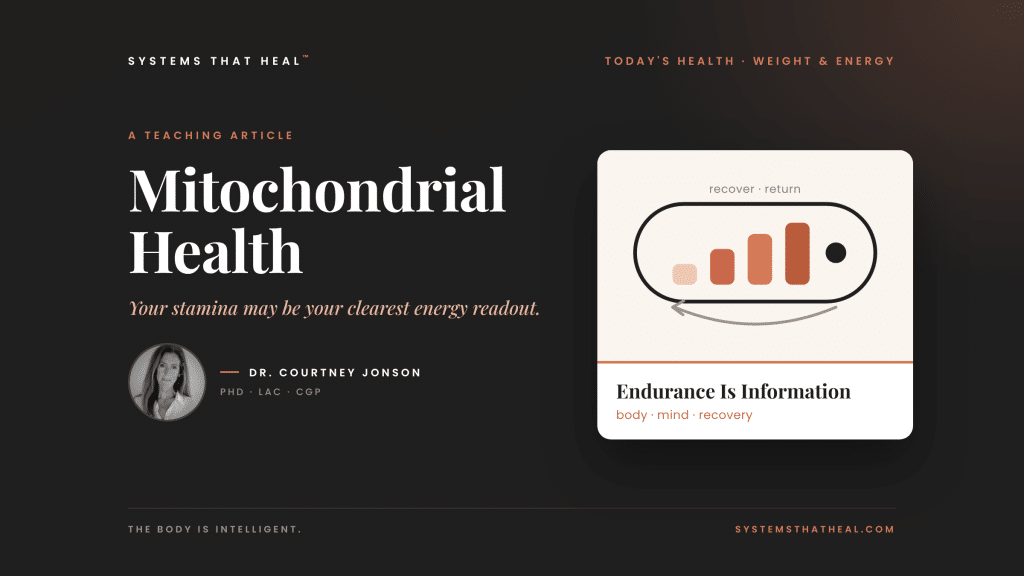
It’s this: What if your stamina is information?
In short: Physical and mental endurance draw on the same energy system, and both may reflect your mitochondrial health. When stamina shrinks and recovery slows, it often points toward mitochondria working under strain from conditions like unstable blood sugar, poor sleep, shifting hormones or high inflammatory load. Mitochondria respond to those conditions, which means endurance can be rebuilt, in the right order.
Endurance is a window, not a willpower test
My teacher of over 20 years, Dr. Datis Kharrazian, puts it simply: a person’s physical endurance and cognitive endurance are clinical windows into their mitochondrial capacity.
I’ve watched that hold true in practice for a long time.
Your muscles and your brain are among the most energy-hungry tissues in your body. When energy production comes under strain, they are often the first places it shows. The legs don’t come back after a run. The mind can’t hold a long meeting, a hard conversation or a complicated email.
We tend to treat these as separate problems. Fitness over here, brain fog over there.
But they may be two readouts of the same system.
Limited endurance, in body or mind, may reflect mitochondria that are working hard just to keep up. It isn’t a diagnosis. It’s a signal worth reading.
What mitochondrial health actually means
You probably learned that mitochondria are the powerhouse of the cell. That’s true. It’s also a third of the story.
Mitochondria do three jobs:
- Energy. They turn food and oxygen into ATP, the fuel nearly every process in your body runs on.
- Building. They help make some of the body’s raw materials, including part of the machinery that carries oxygen in your blood.
- Signaling. They send messages that shape immune activity, stress responses, hormone signaling and repair. Researchers describe them as signaling organelles, not just batteries.
So mitochondrial health isn’t only about how much energy you make. It’s about how well your cells communicate, adapt and recover.
Mitochondria are also not fixed. Your body builds new ones, joins and divides them, and clears out worn ones in an ongoing cycle of renewal. (I walk through that cleanup cycle in Longevity Is Resilience.)
That renewal is the hopeful part. It’s why endurance can change.
Why endurance drops: adaptation, not failure
Here’s what I want you to hear first. Your mitochondria aren’t failing you.
They are adapting to the conditions they’ve been given.
When those conditions are supportive, the body builds more mitochondria, keeps them renewed and lets them run efficiently. When conditions are stressful for long enough, the body tends to do the sensible thing. It conserves.
It may build fewer new mitochondria. It may slow the cleanup of worn ones. It may redirect resources away from output and toward protection.
From the inside, conservation feels like this: less stamina, slower recovery, an afternoon wall, a mind that tires before the day is done.
That isn’t a body breaking down. It’s a body budgeting.
The work, then, isn’t to push harder against the budget. It’s to change what the body is budgeting for.
The six conditions your mitochondria respond to
In his clinical model, Dr. Kharrazian maps the conditions that support or strain each stage of mitochondrial life: building, joining, protection, energy production and renewal. I’ve translated that map into six conditions you can recognize in your own life.
1. Use
Mitochondria are built in response to demand. Physical activity signals your muscles to make more of them. Mental challenge appears to do something similar for the brain.
Long stretches of inactivity, physical or cognitive, send the opposite message: we don’t need this much capacity.
2. Hormones
This is the part most mitochondria articles leave out.
Estrogen and testosterone appear to support the building of new mitochondria and the way they join and share resources. Progesterone appears to support their antioxidant protection.
When those hormones decline or shift, mitochondrial support can shift with them.
3. Steady fuel and thyroid
Energy production depends on a steady supply of fuel and a signal to use it.
Stable blood sugar gives mitochondria a predictable supply. Thyroid hormone helps set the pace of energy production across nearly every tissue. When blood sugar swings or thyroid signaling runs low, ATP production can lag. (More on how this begins in Blood Sugar Dysregulation.)
4. Oxygen and raw materials
Mitochondria need oxygen delivered and nutrients on hand.
That means enough iron and healthy red blood cells to carry oxygen, and a diet dense in minerals and vitamins. Colorful plants rich in flavonoids and sulfur-rich foods like eggs, onions, garlic and cruciferous vegetables help supply the body’s own antioxidant defenses.
5. Total load
Making energy produces some wear, in the form of reactive oxygen species. In small amounts, that wear is a useful signal. In large amounts, it accumulates.
What tends to raise it: systemic inflammation, chemical and toxin exposure, lingering infections, some medications, and chronically high insulin.
This is why fatigue so often travels with inflammation and blood sugar patterns. They may be drawing on the same system. (I write about how these patterns feed each other in The Root Cause of Fatigue.)
6. Rhythm
Mitochondria are renewed largely during rest.
Healthy sleep, a consistent daily rhythm and some space between meals give the body its windows to clear worn mitochondria and replace them. Short sleep, irregular schedules and constant grazing narrow those windows.
Why midlife often shows up as endurance first
Look at that list again with a woman in perimenopause in mind.
Estrogen and progesterone are shifting. Sleep often gets lighter. Blood sugar can become less forgiving. Inflammation may rise.
Several of the six conditions change at once. So it makes sense that many women first notice midlife not as hot flashes, but as stamina: workouts that don’t come back, afternoons that fade, a mind that tires early.
Men can see a version of this too, as testosterone declines and recovery slows.
This is not decline as destiny. It’s a change in conditions. And conditions can be supported.
Signs your mitochondrial health may be under strain
These patterns may reflect energy production working under load. On their own, none of them is a diagnosis.
In the body – Workouts that take two or three days to recover from – Losing strength or stamina even while staying active – Feeling heavy or drained after meals – Needing caffeine or sugar to get through the afternoon – Feeling cold more easily than you used to
In the mind – Focus that fades by mid-afternoon – Difficulty holding long conversations or complex tasks – Reading the same passage more than once – Mental fatigue that arrives before physical fatigue
In blood work, I don’t look for one marker that explains everything. I look at how markers lean together:
- Do fasting glucose, fasting insulin and A1c suggest steady fuel, or swings?
- Does the thyroid picture point toward a slower energy pace?
- Where are the sex hormones, given this person’s age and stage?
- Are ferritin and the complete blood count adequate to carry oxygen?
- Is there a quiet inflammatory signal, like a raised CRP?
One more thing matters here. Low endurance has other explanations too: anemia, a thyroid condition, poor sleep, low mood, simple deconditioning. That’s exactly why the pattern matters more than any single sign. The question is always what this body is adapting to.
A simple endurance check
This isn’t a test. It’s a way of paying attention for a week or two.
- Can you finish the effort you planned? A walk, a workout, a full workday.
- Are you recovered by the next day? Physically and mentally.
- Can you hold your focus through the afternoon? Without needing something to prop it up.
If the answer to two or three of these is often no, your endurance may be telling you something about your mitochondrial health. And that’s useful, because it gives you a starting point.
Supporting mitochondrial health, in order
If mitochondria respond to conditions, the order you change those conditions in matters.
Regulation precedes repair. A body that’s conserving won’t respond well to more demand until the basics are steady. So I build from the ground up.
1. Fuel adequately. Enough food and enough protein to give the body raw material. Under-eating often hides inside “eating clean,” and it tells the body to conserve.
2. Steady blood sugar. Protein at each meal, starches paired with protein and fat, fewer swings through the day. Predictable fuel is the foundation of predictable energy.
3. Protect sleep, rhythm and nervous-system load. Morning light, a consistent wake time, darkness at night, and real recovery from stress. A body braced for threat spends its energy on protection. (See The Vagus Nerve: The Regulator of Resilience.)
4. Nutrients from food. Color on the plate, sulfur-rich foods, adequate protein and minerals. Food first.
5. Lower inflammatory load and support the gut. A gut that can absorb nutrients, and fewer inputs that keep the immune system on alert.
6. Look at hormones and thyroid with a clinician. If endurance is still low once the foundations are steady, this is often where the next layer of the pattern lives.
7. Then add the challenge. Strength training, intervals, mental challenge, heat. Each one dosed to what you can recover from, and adjusted when recovery slips.
Challenge works best when it stays inside what the body can complete. Too little sends no signal. Too much, without recovery, adds wear instead of building capacity.
One nuance worth knowing: research suggests that high-dose antioxidant supplements taken right around training may blunt some of the adaptation signal exercise is meant to send. Antioxidants from food are a different story.
Supplements have a place, but only for a confirmed, tested deficiency. Never as a stack to replace the order above. And any change to a prescribed medication stays with the clinician who prescribed it.
This is the same sequence that runs through all of my work. (Why the order decides the outcome: The Sequence Is the Method.)
Back to the system
Endurance is capacity made visible.
It’s how much your body and mind can meet, and still return.
When it shrinks, that isn’t a verdict on your discipline or your age. It’s your body showing you where it’s conserving, and what it may need before it can give more.
Mitochondria are renewed every day. They respond to how you eat, sleep, move, rest and recover. They respond to your hormones, your load and your rhythm.
That’s the hopeful part.
The body is intelligent. It grows into what it can recover from.
Go further
If you’d like to understand what’s shaping your own endurance, the next step is a Case Review: a functional blood panel, a Report of Findings that reads your results as patterns, and a one-on-one consultation to decide where in the sequence you begin.
This is a teaching practice. Care here comes with the understanding behind it, so what changes stays yours.
Frequently asked questions
What are the signs of poor mitochondrial health?
Common signs include low stamina, slow recovery after exercise, an afternoon energy crash, mental fatigue during long tasks, and feeling cold more easily. These patterns may reflect mitochondria under strain, but they have other possible causes too, so they’re best read alongside blood work and the bigger picture.
Can you improve mitochondrial health naturally?
Mitochondria are renewed continuously and respond to conditions. Adequate fuel, steady blood sugar, good sleep and rhythm, nutrient-dense food, lower inflammatory load and well-dosed movement all appear to support them. Order matters: the foundations come before adding harder training.
Why do I crash in the afternoon?
An afternoon crash often points toward blood sugar swings, short or poor-quality sleep, or a body running low on reserve. It can also reflect strain on energy production. Looking at meals, sleep and stress load together usually tells you more than any single fix.
Why does it take me days to recover from exercise?
Slow recovery may mean the training dose is more than your body can currently complete, or that recovery conditions like sleep, fuel and blood sugar are thin. Hormone shifts in midlife can also slow recovery. Building the foundations first, then adjusting intensity, tends to help.
Do hormones affect mitochondria?
Yes. Estrogen and testosterone appear to support the building and joining of mitochondria, progesterone appears to support their antioxidant protection, and thyroid hormone helps set the pace of energy production. This is one reason endurance often changes during perimenopause and with declining testosterone.
What supplements help mitochondria?
I don’t start with supplements. Fuel, blood sugar, sleep, food and load come first, because supplements can’t compensate for those conditions. When testing confirms a specific deficiency, targeted support makes sense. High-dose antioxidants taken around workouts may blunt the training effect.