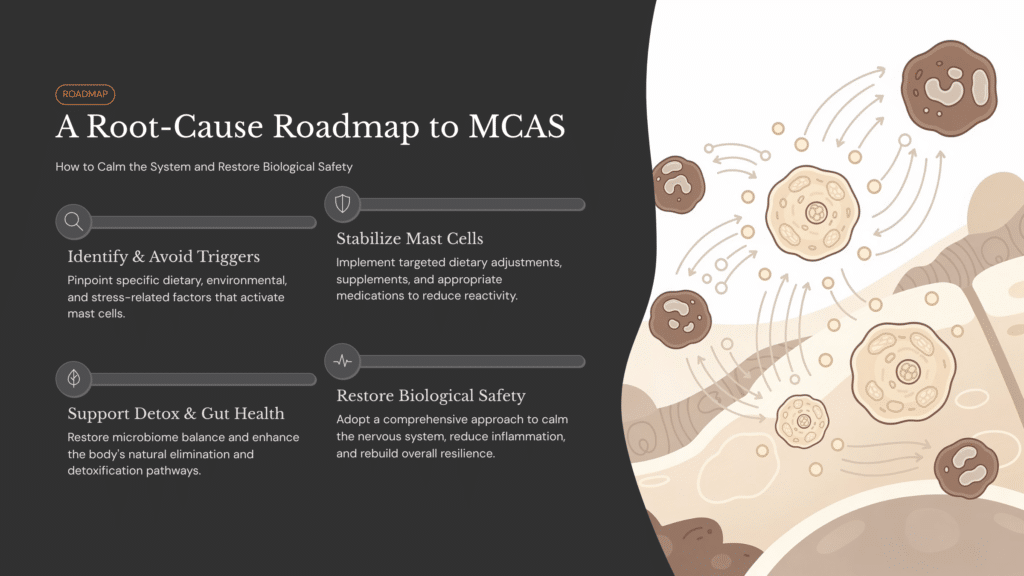
A Root-Cause Roadmap to MCAS – How to Calm the System and Restore Biological Safety
There is a growing population of people who feel like their bodies are “overreacting” to everything.
Foods that once felt nourishing now trigger symptoms.
Stress feels amplified.
The environment feels overwhelming.
And the most frustrating part? The symptoms don’t seem to connect.
Headaches. Skin flares. Anxiety. Gut issues. Fatigue.
From a conventional lens, these are treated as separate problems.
But from a systems biology perspective, they are not separate at all.
They are signals of a system that has lost its ability to regulate.
What Is Histamine Intolerance and MCAS?
Histamine is not the enemy.
It is a critical signaling molecule involved in:
- Immune response
- Gastric acid production
- Neurotransmission
- Inflammatory signaling
Histamine Intolerance
Occurs when the body cannot properly break down histamine, leading to accumulation.
This is most often related to:
- Low DAO (diamine oxidase) activity in the gut
- Impaired methylation pathways (HNMT enzyme)
- Gut inflammation blocking normal degradation
Mast Cell Activation Syndrome (MCAS)
Is a regulation disorder of the immune system. See this post and video for more information.
Mast cells—your body’s frontline defenders—become:
- Hyper-responsive
- Easily triggered
- Chronically activated
They begin releasing:
- Histamine
- Cytokines
- Prostaglandins
- Leukotrienes
In response to things that should not be perceived as threats. This is not just “too much histamine.” This is a loss of immune tolerance.
The Pattern Beneath the Symptoms
Histamine and MCAS rarely present as a single symptom.
They present as a pattern of reactivity across systems:
Neurological
- Headaches or migraines
- Anxiety or panic sensations
- Brain fog
- Sensory sensitivity
Cardiovascular
- Heart palpitations
- Dizziness or lightheadedness
- Fluctuations in blood pressure
Respiratory
- Nasal congestion
- Sinus pressure
- Asthma-like symptoms
Gastrointestinal
- Bloating
- Diarrhea or urgency
- Reflux
- Food sensitivities
Skin & Immune
- Flushing
- Hives or rashes
- Itching
Hormonal
- PMS
- Estrogen dominance patterns
- Cycle irregularities
Why This Happens
Histamine dysregulation is never random.
It is the result of multiple systems losing communication with each other.
1. The Gut–Immune Axis Breakdown
- Leaky gut increases antigen exposure
- Dysbiosis produces histamine or blocks its breakdown
- SIBO, candida, and mold further amplify inflammation
The gut becomes a constant trigger zone.
2. Impaired Histamine Clearance
- Low DAO enzyme production
- Nutrient deficiencies (B6, copper, vitamin C)
- Methylation bottlenecks (MTHFR patterns)
Histamine is produced normally—but not cleared efficiently.
3. Nervous System Dysregulation
- Chronic stress shifts the body into sympathetic dominance
- Vagus nerve tone declines
- Mast cells become more reactive under stress chemistry
The system loses its “brakes.”
4. Environmental Load (The “Total Bucket”)
- Mold exposure
- Toxins (pesticides, heavy metals)
- Chemical sensitivities
The immune system is already overwhelmed.
5. Hormonal Influence
- Estrogen increases histamine release
- Histamine stimulates estrogen production
A feedback loop is created. This is why symptoms often worsen around the menstrual cycle
The Histamine “Bucket” Concept
One of the most important frameworks:
Think of histamine as filling a bucket.
- Food adds to the bucket
- Stress adds to the bucket
- Toxins add to the bucket
- Hormones add to the bucket
When the bucket overflows…Symptoms appear.
The goal is not just to remove one trigger.
The goal is to lower the total load while restoring regulation.
A Step-by-Step Approach to Stabilization and Healing
Healing histamine intolerance and MCAS is not about restriction forever.
It is about restoring capacity.
Phase 1: Lower the Load (Stabilization)
This is where we create immediate relief.
Nutrition
- Short-term low-histamine approach
- Freshly cooked foods only
- Avoid leftovers, fermented foods, alcohol
Cooking Methods
- Gentle cooking (boiling, steaming)
- Avoid grilling, charring, slow-cooking
Goal: Reduce incoming histamine while the system calms
Phase 2: Stabilize Mast Cells
Now we support the immune system directly.
Key Nutrients
- Quercetin (mast cell stabilizer)
- Vitamin C (histamine degradation)
- Magnesium (nervous system support)
- Vitamin B6 (DAO support)
- DAO enzyme (short-term support with meals)
Herbal Support
- Nettle
- Luteolin
- Holy basil
Goal: Reduce reactivity threshold
Phase 3: Repair the Gut
This is where long-term healing begins.
Foundational Strategy
- GAPS-style meat stock
- Low-histamine ketogenic or carnivore reset (short-term)
Remove Drivers
- SIBO
- Yeast overgrowth
- Parasites
- Mold-related gut disruption
Rebuild
- Collagen + glycine
- Minerals (especially sodium, potassium)
- Butyrate support
Goal: Restore barrier function and immune tolerance
Phase 4: Regulate the Nervous System
This step is often overlooked—but essential.
Daily Rhythm
- Consistent sleep-wake cycle
- Morning light exposure
- Structured meals
Practices
- Breathwork
- Gentle movement
- Improving your vagal tone – Vagal toning exercises
Avoid
- Overtraining
- Excess stimulation
Goal: Re-establish safety in the body
Phase 5: Address Deeper Root Causes (In Sequence)
Only once stability is established do we go deeper.
- Mold detoxification
- Environmental toxin support
- Nutrient repletion
- Hormonal rebalancing
Then we can:
Carefully reintroduce foods
Expand diet diversity
Rebuild resilience
Tracking Progress
Healing is not linear—but it is trackable.
We look for:
- Fewer flares
- Faster recovery
- Increased food tolerance
- More stable energy and mood
- Improved sleep
Tools:
- Food + symptom journal
- Cycle tracking
- Environmental awareness
- Stress pattern recognition
The Deeper Truth
Histamine intolerance and MCAS are not random diagnoses.
They are: A signal that the body has lost its ability to regulate safely
When we:
- Lower the load
- Restore the gut
- Calm the nervous system
- Rebuild internal communication
The system begins to remember how to stabilize.
This Is the Work
Not suppression.
Not endless restriction.
But restoration.
When the body feels safe again…
When communication is restored…
Reactivity gives way to resilience.