
The first cold of the season, right on schedule.
Skin that tightens and cracks the week the furnace comes on.
A gut that suddenly slows down, or won’t settle.
Sinuses that close up. A cough that lingers past the cold.
And underneath it, something harder to name. A heaviness that arrives as the light leaves. Old losses that feel close again.
Most of us treat these as separate problems. A cold. Dry skin. A gut thing. A mood.
I see them as one question: why do the body’s boundaries get loud in autumn?
In short: In Chinese medicine, autumn belongs to the Metal element, which governs the lung, the large intestine and the skin: the places where the body meets the world. Modern physiology describes the same surfaces as barrier systems, whose real job is tolerance, deciding what to let in and what to let go. Autumn puts these boundaries under load, and how they respond reflects the conditions underneath them.
Metal in Chinese Medicine: The Season of the Boundary
Chinese medicine maps the year through five elements. Each one has a season, a pair of organs, and a movement.
Autumn is Metal.
Its organs are the Lung and the Large Intestine. One takes in. One lets go.
The Lung draws in breath, and with it, what the classical texts call qi: the vital input from the outside world. The Large Intestine does the opposite job. It extracts what’s still useful, then releases the rest.
Metal also governs the skin, sometimes called the third lung. Lung, colon and skin are the three surfaces where you end and the world begins.
At that surface sits what Chinese medicine calls Wei qi, the protective layer. It is said to circulate just beneath the skin, warding off what the texts call external pathogens: wind, cold, dryness.
The movement of autumn is inward and downward. Sap returns to the roots. Leaves let go. The year gathers what it needs for winter and releases what it doesn’t.
And Metal’s emotion is grief. Not as a disorder. As a function: the work of letting go of what has ended, so that what remains can be kept.
The Same Map, in Physiology
Here is what stops me every autumn.
Strip away the poetry, and modern physiology describes nearly the same territory.
Your body has three large surfaces exposed to the outside world:
- The airway lining, from the nose down into the lungs
- The gut lining, the largest of the three by far
- The skin
Each one is built on the same plan. A single layer of cells, sealed together by tight junctions. A layer of mucus or oil on top. Immune cells waiting just beneath. And a community of microbes living on the surface, part of the barrier itself.
On the airway and gut surfaces, the body secretes an antibody called secretory IgA. It doesn’t destroy. It binds and neutralizes, keeping things at the surface rather than letting them through.
I don’t think Wei qi is barrier immunity. They come from different ways of seeing. But they point at the same thing: a living, intelligent layer at the surface of the body that decides what gets through.
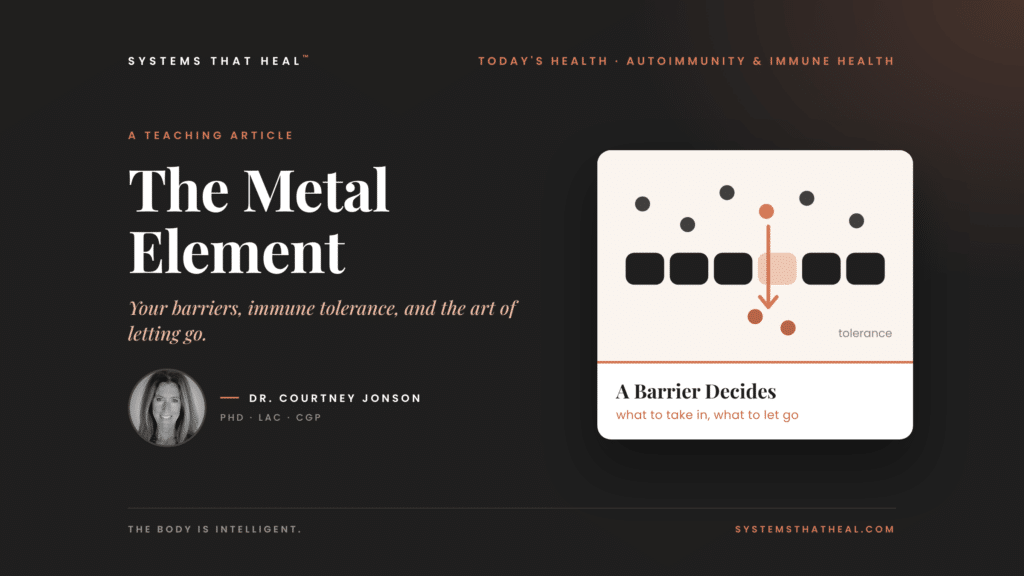
Tolerance: A Barrier Is a Decision, Not a Wall
We tend to imagine the immune system as a defense force. Attack what’s foreign.
But most of what crosses your boundaries every day is harmless. Food. Pollen. Dust. The trillions of microbes in your gut.
So the immune system’s harder job isn’t attacking. It’s knowing what not to attack.
That skill is called immune tolerance. It’s carried in part by regulatory T cells, immune cells whose job is to calm a response that isn’t needed. The gut is where much of this learning happens. The body is exposed to food proteins there every day, and in most people it learns to leave them alone.
When tolerance holds, a boundary can stay open to nourishment and still keep out what doesn’t belong.
When it slips, the body may start reacting to things it once accepted. New food reactions. Seasonal allergies that get worse every year. Skin that flares. In some people, autoimmune patterns, where the immune system loses tolerance for the body’s own tissue.
The Lung and the Large Intestine, Paired Again
Chinese medicine paired the Lung with the Large Intestine thousands of years ago. For a long time, that pairing made little sense to Western medicine.
Then researchers began describing the gut-lung axis.
When the bacteria in your colon ferment fiber, they produce short-chain fatty acids, butyrate among them. These compounds feed the cells of the colon lining. They also appear to support regulatory T cells, and their influence seems to reach beyond the gut. In animal studies, and in early human research, a healthier gut microbial environment is associated with calmer immune responses in the airways.
The research is still young, and I hold it lightly.
But it fits the pattern the old map drew: what the large intestine does with what it’s given may shape how the lung meets the world.
Why Autumn Loads the Boundaries
Autumn changes the conditions at every one of these surfaces at once.
Less sun. Your skin makes vitamin D from sunlight, and as the days shorten, that production falls. At northern latitudes, it may slow to almost nothing through the winter. Vitamin D plays a part in barrier integrity and in how immune cells calibrate their response.
Drier air. Cold outdoor air and indoor heating both pull moisture from the airway lining. The mucus layer that traps and clears particles works best when it’s hydrated. When it dries, clearance may slow.
More time indoors. Closer quarters, more shared air, more circulating viruses.
Shifting rhythms. Later mornings, earlier dark, a change in what and when we eat. Each one is a signal the body has to adjust to.
Stress and grief. The stress response communicates directly with barrier tissue. Stress hormones and the mast cells that sit at these surfaces can influence how tightly the gut lining holds. A heavy season, emotionally, can be a heavy season for the barrier too.
Any one of these is manageable. Arriving together, they add up.
Adaptation, Not Failure
This is the part I most want you to hear.
A boundary that reacts in autumn is not a broken boundary.
It’s a boundary doing its job under a heavier load. The cold, the flare, the gut that tightens up: each one is a signal about conditions. Dryness. Depletion. A system that has been running on reserve since summer.
The question isn’t what is wrong with my immune system?
It’s what is my body adapting to, and what does it need to hold its ground?
Patterns I Look For
When autumn hits someone hard, year after year, I start looking at the whole picture rather than the single symptom.
Signs that the boundaries are under load:
- Catching every cold that goes around, or one that lingers for weeks
- Sinus congestion or a cough that returns each fall
- Dry, itchy or flaring skin as the weather turns
- Bowel changes: slower, looser, or swinging between the two
- New reactions to foods that used to be fine
- A seasonal heaviness or low mood that arrives with the dark
Questions I bring to the bloodwork:
- Where is vitamin D sitting going into winter, before the darkest months?
- What is the white blood cell pattern suggesting about how the immune system is working right now?
- Is blood sugar steady enough to support repair, or is the body spending its reserve managing swings?
- Is there an inflammatory signal, and does it fit the rest of the picture?
None of these is a diagnosis on its own. Together, they start to show what conditions the body is adapting to.
How to Support Your Boundaries This Season
Here is the order I work in. It matters. A barrier can’t hold if the system underneath it is running on empty.
1. Fuel adequately. As the weather cools, the body asks for more. Enough protein and enough fat give the barrier tissue what it needs to keep rebuilding. Barrier cells turn over constantly, and they need the materials.
2. Stabilize blood sugar. Swings in blood sugar are a stress signal, and stress signals reach the barrier. Steady meals, built around protein, come before anything more targeted. (Blood sugar dysregulation is often the pattern underneath.)
3. Sleep, rhythm and stress load. Autumn hands you longer nights. Use them. Earlier, darker evenings and morning light help the body hold its rhythm. And leave room for grief, if it comes. Letting something end is part of the season’s work, not a detour from it. (The vagus nerve is where much of this regulation lives.)
4. Nutrients from food. The barrier depends on a few nutrients in particular.
- Vitamin A, from liver, egg yolks and butter, supports the integrity of the lining surfaces.
- Zinc, from red meat and shellfish, supports tight junctions and immune signaling.
- Bone broth offers gelatin and minerals in an easy-to-absorb form.
- Vitamin D: test it rather than guess. If it’s low, supplementing a confirmed deficiency makes sense. Otherwise, food and sunlight come first.
5. Gut and barrier care. Regular elimination is part of the Large Intestine’s job of letting go, so pay attention to it. Fermented foods, as tolerated, support the microbial layer. A humidifier at night and breathing through the nose help keep the airway lining moist.
What I don’t recommend is a stack of immune supplements in September. If the conditions underneath aren’t in place, there’s little for them to build on. If you’re already working with a prescriber, keep any medication changes with them.
Turning In
Autumn asks the body to do two things at once: hold its boundaries, and let go.
That isn’t a contradiction. It’s what a healthy barrier does every day. It takes in what nourishes. It releases what doesn’t belong. It knows the difference.
The Metal element has a word for this: refinement. Keeping what is essential. Letting go of the rest.
Turning in isn’t withdrawal. It’s the season of tending the boundary, so that you meet winter with your ground already steady.
If your autumns follow the same pattern every year, it may be worth seeing what your body has been adapting to. That’s what a Case Review is for.
Related reading: Gut health and autoimmunity · Mast cell activation · The Sequence Is the Method
Frequently Asked Questions
What is the Metal element in Chinese medicine?
Metal is one of the five elements Chinese medicine uses to describe the cycles of nature and the body. It belongs to autumn, governs the lung and large intestine, and is associated with the skin, the breath, and the emotion of grief. Its movement is inward and downward: gathering what’s essential and releasing the rest.
Why are the lung and large intestine paired?
In Chinese medicine, the Lung and Large Intestine are paired organs. The Lung takes in and the Large Intestine lets go. Modern research on the gut-lung axis suggests a physical link too: compounds made by gut bacteria may help shape immune responses in the lungs.
What is the gut-lung axis?
The gut-lung axis describes the two-way communication between the gut and the lungs. Short-chain fatty acids made when gut bacteria ferment fiber appear to influence immune cells beyond the gut, including in the airways. The research is still developing, much of it in animal studies.
Why do I get sick every fall?
Autumn changes several conditions at once: less sunlight for vitamin D, drier air that dries the airway lining, more time indoors, shifting sleep and stress. Together, these put the body’s barriers under load. A pattern that repeats every year is worth looking at as a whole, not as a series of separate colds.
Is grief connected to the lungs?
In Chinese medicine, grief is the emotion of the Metal element and the Lung. In physiology, emotional stress communicates with barrier tissue through stress hormones and immune cells. Neither says grief causes illness. Both suggest that what you carry emotionally and how your boundaries hold may not be separate.


